
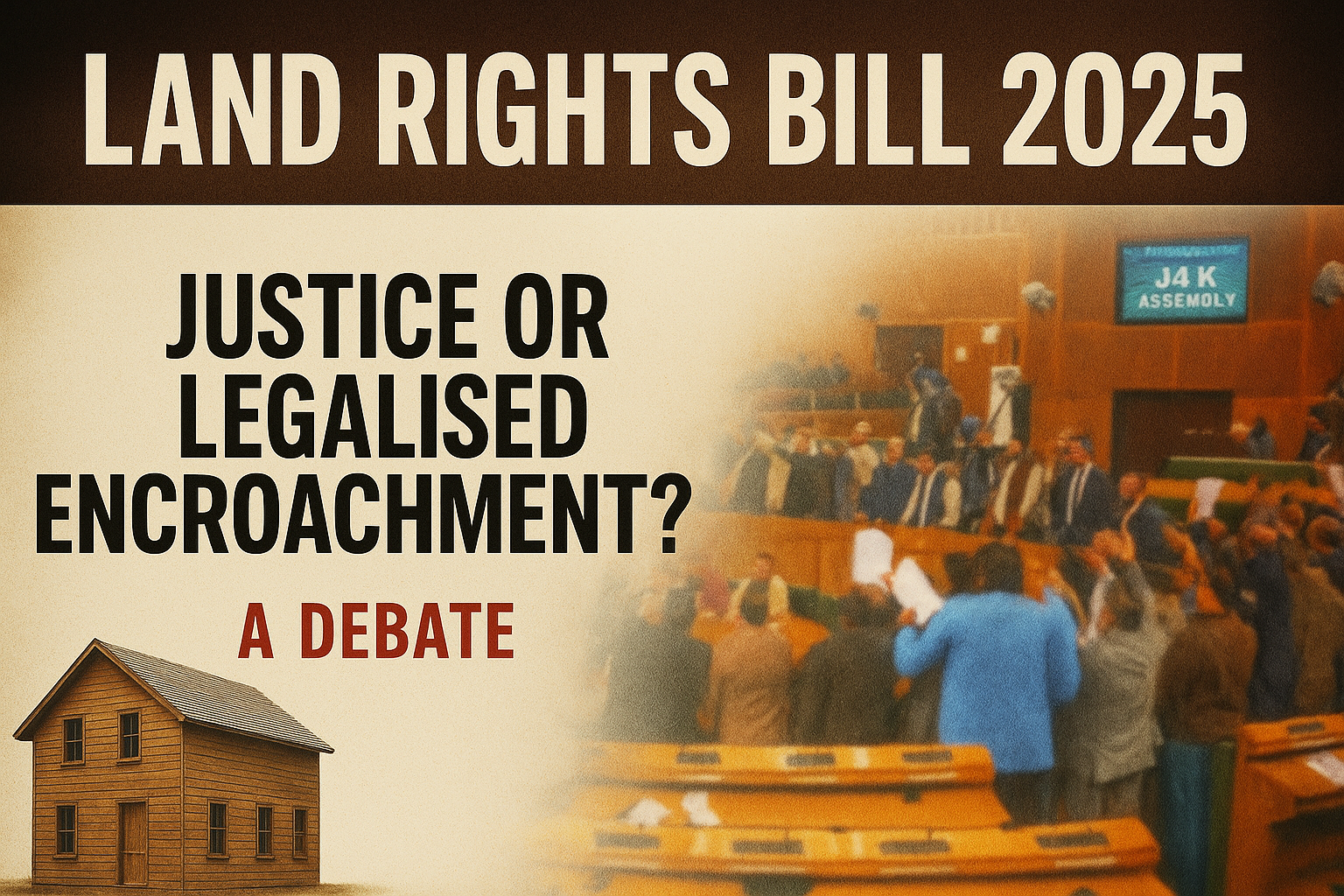
Land Rights Bill 2025: Justice or Legalised Encroachment?
The Land Rights Bill 2025 proposed by PDP leader Waheed ur Rehman Para in the Jammu & Kashmir Assembly has once again fueled a long debate on justice, ownership, and accountability. The bill aimed to provide proprietary rights to residents who have lived for decades on government or “state land,” citing the right to shelter under Article 21 of the Constitution.
The proposal, though, was quickly rejected by both the National Conference and BJP, who concurred unusually that it was legally and politically untenable.
Its proponents claimed that the bill was a humanitarian step for poor families who have resided on these lands for generations, frequently uprooted by war or natural calamities. Its proponents do not see it as a reward for doing something wrong but as acknowledging the ground realities. Residents have sunk their savings into constructing dwellings and paying electricity bills but live with the perpetual threat of eviction. For them, this bill meant security and respect.
But critics have a different view. They contend that such a law would legitimize encroachment, undermine state authority over public and forest land, and create a bad precedent, paving the way for future occupations with the hope of eventual regularization. The failure of the Roshni Act, which was once hailed as a comparable reform is an example of how quickly good policies can be transformed into instruments of corruption and elite capture.
Environmentalists have also cautioned that regularising homes in ecologically fragile zones could worsen floods and landslides, a serious risk in Kashmir’s terrain.
While the bill’s defeat closes one chapter, it leaves open the question of land justice in J&K. Thousands still face eviction without a transparent rehabilitation policy.
The government has to now take the middle ground, one that does not incentivize encroachment but safeguards bona fide residents. A new policy, based on transparent eligibility, social audits, and environmental protection, might weigh legality against compassion.
The Land Rights Bill 2025 has perhaps politically faltered, but it succeeded in revealing a moral reality: Kashmir’s land issue is not about possession, it’s about dignity, belonging, and survival.