
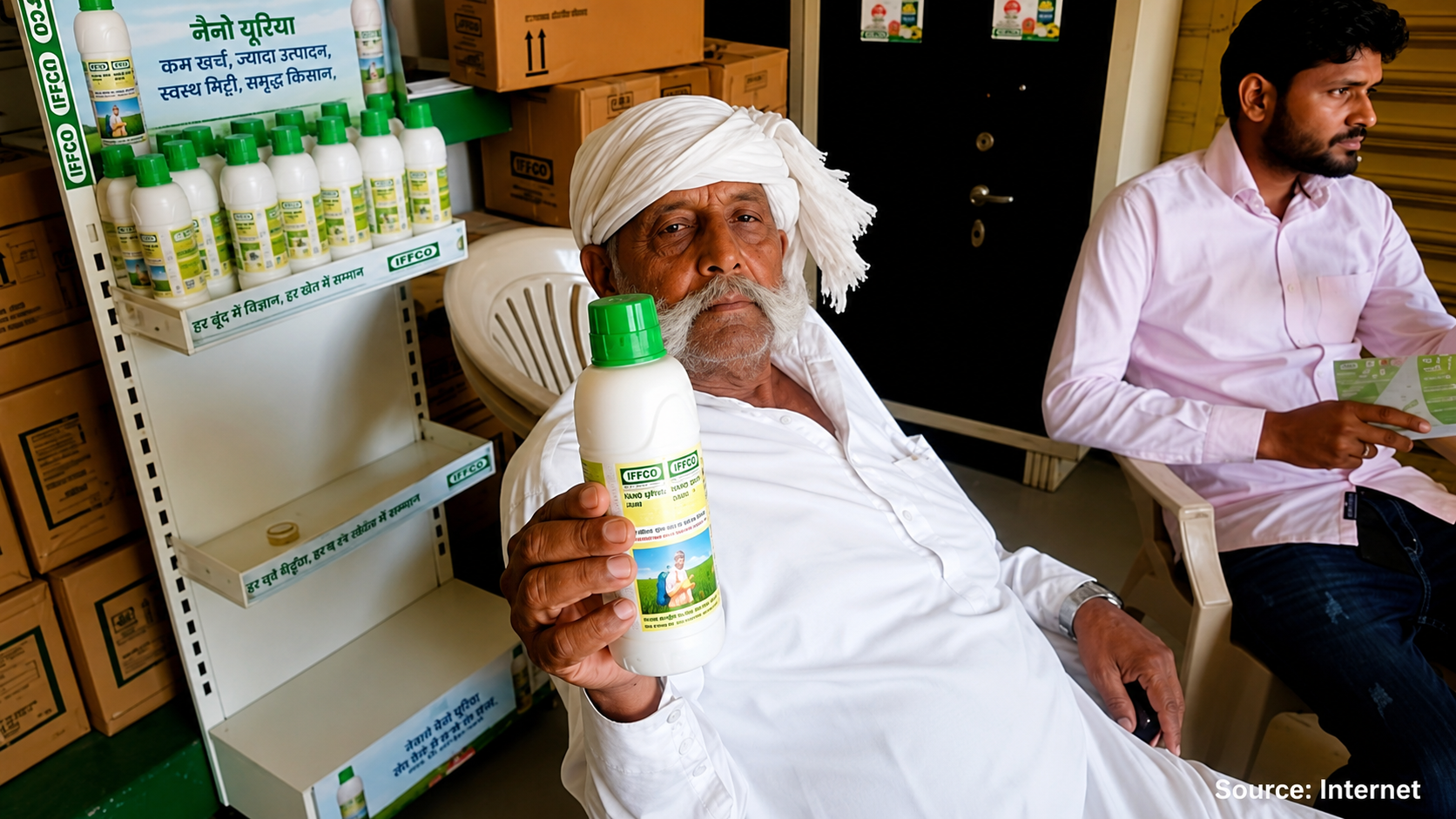
Farmers ask for evidence, education and choice as the product is promoted across the region
The Public Tv| News Desk
A new fertiliser technology is being introduced to farmers in Jammu and Kashmir with a promise that sounds appealing: use less conventional urea, improve nitrogen-use efficiency and maintain or even increase crop yields.
But as Nano Urea finds its way into the farming community, an important question is beginning to emerge from the ground:
Are farmers being properly educated about the product before they are asked to buy and use it?
IFFCO has promoted Nano Urea as a scientific innovation and has cited research in support of its benefits. Similar promotional claims have been made for other nano fertilisers, including Nano DAP, Nano Zinc and Nano Copper.
Yet independent researchers have raised questions about the strength and scope of the scientific evidence behind some of these claims.
A 2023 paper published in the peer-reviewed journal Plant and Soil examined IFFCO’s claims alongside the available scientific literature on foliar nano fertilisers. The authors argued that several claims regarding yield enhancement, plant uptake and environmental benefits were not adequately supported by the evidence available to them. They also called for further independent research into the efficacy, mechanism of action, environmental risks and long-term implications of nano fertilisers.
The paper did not establish that Nano Urea is universally ineffective, nor does it mean that every farmer using the product will experience a loss. Rather, it raises a legitimate scientific question: are the benefits being communicated to farmers stronger than what the independent evidence currently allows us to conclude?
That distinction matters.
Because ultimately, the person taking the risk is not sitting in a laboratory
It is the farmer standing in his field.
The bigger concern: awareness before purchase
During ground interactions in Jammu and Kashmir, some farmers have alleged that they were encouraged, and in some cases pressured, by distributors or representatives to purchase Nano Urea without receiving adequate information or practical training about its application.
These are allegations and require verification.
But they raise an issue that deserves the attention of the agriculture department, cooperative institutions and the company itself.
A farmer should know when to use the product, how much to use, how it should be applied, what it can and cannot replace, and what scientific evidence supports the expected results.
Most importantly, the decision to purchase should remain an informed choice.
A bottle of fertiliser may not look like a major investment to some. For a farmer, however, the consequences of getting an input decision wrong can extend across an entire crop season.
What farmers deserve
If Nano Urea is genuinely capable of delivering the benefits claimed for it, the best way to establish confidence is not aggressive promotion.
It is transparent science.
Farmers deserve field demonstrations conducted under local conditions. They deserve independent trials and clear comparisons with recommended conventional fertiliser practices. They deserve information in a language they understand, without exaggerated promises.
And if meetings and awareness programmes are being reported as part of the product’s outreach, farmers should be able to confirm that these meetings actually took place and that meaningful training was provided.
Innovation should not mean blind adoption
There is nothing wrong with introducing new technology into agriculture. In fact, farming needs innovation.
But innovation must walk alongside evidence.
The concern is not whether Nano Urea has a future. The concern is whether farmers are being given enough reliable information to decide whether it has a place in their fields today.
IFFCO, its distributors and the concerned authorities should therefore clarify the training and awareness programmes conducted in Jammu and Kashmir, the evidence being presented to farmers, and the safeguards in place to ensure that farmers are not pressured into purchasing a product they do not yet understand.
The farmer should be the first person to understand the innovation not the last person to question it.
The allegations regarding pressure on farmers and the conduct of awareness programmes should be independently verified. IFFCO, its representatives, distributors and the concerned authorities should be given an opportunity to respond to specific allegations before publication. The scientific criticisms referenced above are those of the cited researchers and should not be presented as a final determination on the efficacy or safety of Nano Urea.