


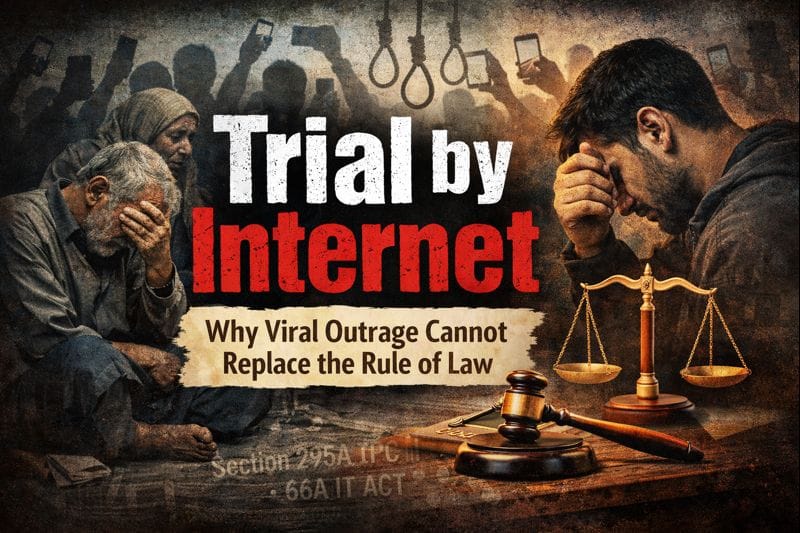

When Virality Becomes Vigilantism: How Social Media Undermines Due Process
A disturbing video recently went viral on social media showing a son physically assaulting his elderly father. On the face of it, the act is morally indefensible. Violence against parents is a serious social and legal wrong, and public condemnation of such behaviour is both natural and necessary. But what followed the video’s virality exposes a far more troubling reality one where social media outrage eclipsed law, ethics, and basic humanity.
It later emerged that the video was recorded nearly a month before it was uploaded. By the time it surfaced online, the matter had already undergone intervention. The police had conducted counselling, the individual had issued a public apology, and the family had reached a form of reconciliation. Legally speaking, the case had been addressed. Social media, however, chose not closure but continuation.
From Crime to Content:
Once uploaded, the video was stripped of context and weaponised for virality. Content creators and anonymous users alike passed instant judgment, branding the man with every conceivable slur. Some went so far as to openly demand his public execution. This was not a call for justice it was digital vigilantism.
The consequences were severe. The man, reportedly the sole breadwinner of his family, faced an informal but ruthless social boycott. He could no longer step out to earn. The punishment, imposed not by a court but by the crowd, extended beyond him and engulfed his entire family.
His parents both in their late seventies his wife, and his three daughters were dragged into a crisis they did not create. Reports suggest the family lives in extreme hardship, lacking even basic household necessities and proper shelter conditions that are especially brutal during Kashmir’s harsh winter. While outrage trended online, a family descended into silence, cold, and hunger.
When Society Becomes Judge, Jury, and Executioner:
What unfolded is symptomatic of a deeper crisis: the collapse of due process in the age of virality. A short clip became a life sentence. There was no inquiry into circumstances, no acknowledgment of legal resolution, and no consideration of proportionality.
India’s legal system, flawed as it may be, is built on principles of due process, reform, and proportional punishment. Social media operates on none of these. It rewards outrage, permanence, and spectacle.
This raises a fundamental question: Does one reprehensible act justify lifelong social exile and the collective punishment of innocent family members?
The Legal Framework: What the Law Says
Under the Indian Penal Code (IPC), acts of physical violence are punishable offences. Sections such as IPC 323 (voluntarily causing hurt) and related provisions empower the police to intervene, investigate, and take appropriate action. In this case, that process reportedly took place.
However, what followed online potentially violates multiple legal provisions:
IPC Section 503 & 506: Criminal intimidation, including threats of death or harm.
IPC Section 509: Acts intended to insult the dignity of an individual.
Section 354D & 507 IPC (where applicable): Online harassment and anonymous intimidation.
Information Technology Act, 2000 – Section 66A (principle, despite being struck down) and Section 67: Though Section 66A was invalidated, courts have repeatedly affirmed that targeted online abuse, threats, and harassment remain prosecutable under other IPC provisions.
Calls for lynching, public execution, and sustained harassment are not expressions of free speech. They fall squarely within the domain of criminal intimidation and cyber harassment.
Media Ethics and the Role of Content Creators:
Equally concerning is the ethical vacuum in which this outrage thrived. Uploading month-old footage with the intent to provoke outrage raises serious questions about malicious intent and digital ethics.
The Press Council of India’s Norms of Journalistic Conduct clearly state that media must:
- Avoid trial by media
- Respect the dignity and privacy of individuals
- Refrain from publishing content that may incite violence or social disorder
While many viral content creators do not identify as journalists, their reach often exceeds that of mainstream media. With influence must come responsibility. Monetising suffering and unresolved narratives is neither activism nor journalism it is exploitation.
Collective Punishment Is Not Justice
The most disturbing outcome of online vigilantism is collateral damage. Elderly parents, minor children, and spouses, none of whom committed the act are forced to endure social isolation, economic deprivation, and psychological trauma.
The law does not recognise collective punishment. Neither should society.
A person who has acknowledged wrongdoing, faced legal intervention, and sought reconciliation must be allowed a path to rehabilitation. Denying this does not strengthen society, it radicalises desperation.
A Moral Reckoning:
As social media users, journalists, and citizens, we must confront uncomfortable truths. Are we seeking justice or entertainment? Reform or revenge?
Moral outrage without restraint becomes cruelty. Justice without humanity becomes oppression
Conclusion:
What happened in the video was wrong. But what happened after may be even more dangerous.
When virality replaces due process, when mobs override courts, and when families are punished for the sins of one individual, society itself stands accused.
A civilised society is not measured by how loudly it condemns wrongdoing,but by how fairly, legally, and humanely it responds to it.
In our digital age, the greatest responsibility lies not just with the offender, but with those who choose to turn suffering into spectacle.